Awareness regarding biodiversity, climate change mitigation and solutions for the decarbonisation of the economy are also critical in the tourism sector today. The growing discussion of responsible tourism and the UN Goals for Sustainable Development shows the importance of implementing actions to address sustainable development in tourist destinations. For this to happen, everyone in the industry must work together to develop and implement best practices, balancing the local needs of the population and promoting a responsible tourism strategy. Integrating new practices does not happen overnight; it also demands time, training, resources, effort, and commitment.
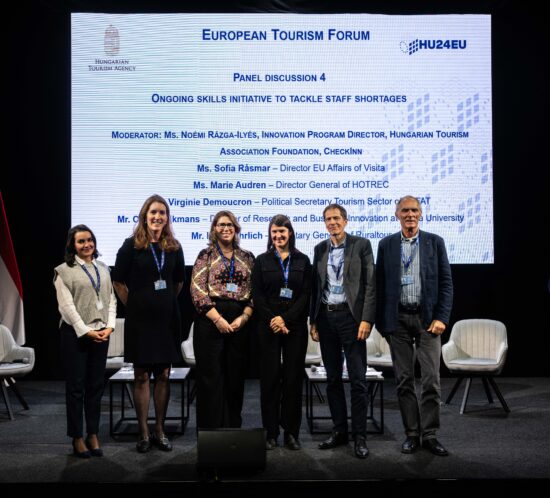
In January 2024 Stanislav Ivanov and Corné Dijkmans participated in the annual ENTER conference. For three decades, the ENTER e-Tourism conference has served as a convergence point for the Tourism and IT sectors, educational institutions, governmental bodies, and various organizations. ENTER provides an unparalleled global platform for engaging in active discussions, sharing insights, and evaluating contemporary research and industrial case studies related to the use of Information and Communication Technologies (ICTs) in the travel and tourism sector.
In a special panel dedicated to the AI impact on tourism education, participants discussed whether AI is an ally or an enemy for those studying tourism and hospitality. The use of generative AI undoubtedly will change the foundation of the education system, but it will also bring new benefits for the students. For example, the use of AI may develop digital and analytical skills, while social and transversal skills remain as a must for everybody in the field of services and hospitality. In this regard, the ability to work with AI becomes an important part of the digital skills set of every educational and training institution.
After the quieter summer months, autumn has brought a flurry of events for us. The vibrant season has given us the opportunity to actively participate in various activities, and we are happy to share the highlights of our efforts. While our previous article focused on our green skills projects (WASTELESS, Plan’Eat and TOURBAN), sustainability and socio-economic issues, now we would like to concentrate on the social skills. We focused on two key areas: Firstly, our commitment to promoting ongoing EU projects has taken us to several events. Secondly, we have been involved in domestic discussions, particularly concerning skills development in the dynamic field of tourism.
Sociology of tourism studies the relationships, roles and motivations of tourists and the ongoing exchanges between tourists, institutions and host communities. It helps us to understand the social and cultural dimensions of tourism, the impact of tourism on people and places, and the potential of tourism as a tool for social and economic development and social justice.
Overtourism is going to be a growing concern for European cities, even if the topic it is not entirely new. For instance, Doxey (1975) proposed an ‘irritation index’, an ideal type model mapping the changing perception of residents towards visitors in an area’s touristic life cycle. In the tourism development of a destination Doxey identified four stages of local responses: after initial enthusiasm about the economic benefits of tourism (euphoria), attitudes tend to change with the growth of visitors. After a while, locals get used to tourists and may become indifferent (apathy). But when the number of holidaymakers exceeds a threshold annoyance comes in (irritation) that may even end in hostile feelings vis-à-vis tourists (antagonism). Obviously, the last two phases are relevant for overtourism. Why are some cities more susceptible to be overrun by tourists than other ones?
The post-coronavirus scenario has brought challenges and opportunities for tourism workers. A new learning scenario has emerged for the global tourism industry. Workation and the digital nomad are key concepts in this phenomenon. There are more and more European destinations that are committed to becoming destinations for this niche market.
Social and cross-cultural skills, often called ‘soft skills’, are among the skills seen as most important for the tourism and hospitality workforce (Wilks & Hemsworth 2011, Sisson & Adams 2013, Weber et al 2009). These skills are highly appreciated by employers in the sector and are also transferable skills that could be easily adapted to different working environments. With the growth of AI and emerging discussions about the displacement of the workforce, social skills are regaining importance with the recognition that many workers in the future will need more complex problem-solving, adaptability and creativity skills. But how can we define these skills?
Finland has a reputation as a leader in environmental policy and sustainable development. The country is highly committed to global Sustainable Development Goals (SDGs) and has been ranked number one in an international comparison of sustainable development in 2021. It has also established itself as a trailblazer in promoting sustainability and green skills development within the tourism industry. With a commitment to preserving its clean nature and minimising environmental impact, Finland has implemented innovative strategies and initiatives that set a global benchmark.
Colleagues of the Pantour consortium; Federturismo Confindustria and Ruraltour went to Singapore to moderate the BILT sessions, focusing on solutions for the digital and green transition in Singapore. What are the digital and green skills we need in the future of tourism? The conference entitled “Hybrid BILT Bridging Event – TVET for Hospitality and Tourism: Solutions for the Digital and Green Transition”, was the first on-site Bridging Event of the BILT project in the Asia-Pacific region. It provides a platform for outlining trends in green and digital qualifications and competencies, with a focus on the hospitality and tourism sector.