

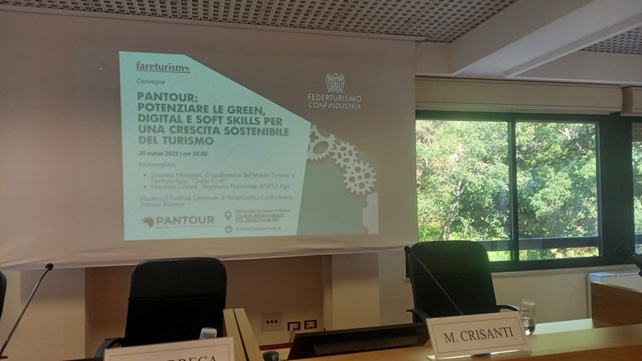
PANTOUR’s national event in Italy: Boosting green, digital, and soft skills for a sustainable growth of tourism
Held within Fareturismo, a premier three-day national event dedicated to job opportunities, training guidance, and tourism policy discussions was organised to disseminate PANTOUR..
The primary objective of the conference was to disseminate information, share best practices, and facilitate strategic discussions on EU-related matters through the presentation of the Pantour project (Pact for Next Tourism Generation Skills). Funded by the European Union, with Federturismo Confindustria as a partner, Pantour continues the vital groundwork laid by the NTG (Next Tourism Generation Alliance).
The event focused on strengthening the link between the educational ecosystem and the tourism industry. Speakers illustrated the strategic value of emerging competencies, highlighting how investing in targeted training serves as a core competitive advantage and an essential engine for the sustainable and resilient future of the sector.
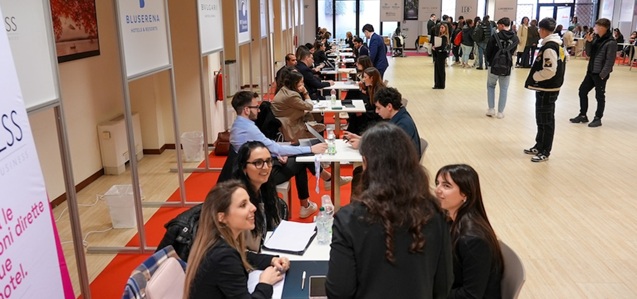
The conference leveraged the highly dynamic environment of Fareturismo, which bridges employment matchmaking (such as HR selection interviews with leading companies) with academic and professional development.
The session ensured the involvement of diverse and prestigious stakeholders to foster a broad exchange of ideas.
Multi-Stakeholder Synergy: Empowering High-Level Dialogue
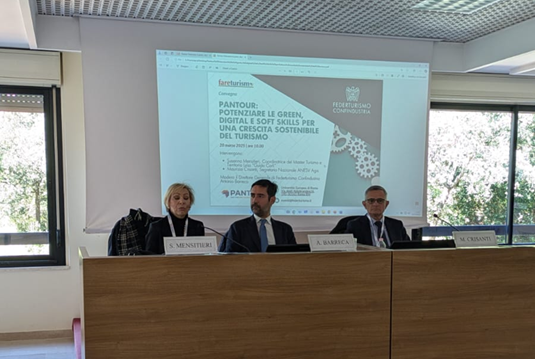
To foster a truly comprehensive exchange of ideas, our recent session brought together a distinguished panel of leaders, each offering a unique lens on the evolving dynamics of the sector.
The conversation was skillfully guided by Antonio Barreca, Director General of Federturismo Confindustria, who set the stage by grounding the dialogue in a strategic national and macroeconomic perspective. Adding a crucial academic layer, Susanna Mensitieri, Coordinator of the Master’s Program in Turismo e Territorio at LUISS University, highlighted the vital role of postgraduate education and institutional training in shaping tomorrow’s leaders. Completing the panel from the business front, Maurizio Crisanti, National Secretary of ANESV, shared invaluable insights on the ground-level operational realities and demands facing private leisure and entertainment enterprises.
This high-level synergy on stage was fully reflected in the room. The audience brought the discussion full circle: a proactive community of students, job seekers, educators, entrepreneurs, employment agencies and regional policymakers, all actively engaged in shaping the future of the labour market.
Driving Real Impact: Key Conference Outcomes
The conference marked a significant step forward in uniting diverse sectors and levels of governance around a shared vision. Beyond inspiring dialogue, the session yielded actionable results that pave the way for long-term collaboration as mapping and bridging Skill Gaps. By bringing key stakeholders around the same table, the event provided critical insight into current labour market mismatches, offering clear directions on how to monitor, identify, and bridge missing digital, green, and soft skills.
Aligning the real-world operational demands of entrepreneurs (such as theme park operators) with advanced academic pathways (like specialized Master’s programs) established the blueprint for updated, market-ready training curricula in order to build an integrated synergy
Crucially, the audience brought this dynamic vision to life: connecting trainers, students, job seekers, and employment agencies.
This unique multi-stakeholder presence allowed the conference to go beyond theoretical debate and achieve immediate practical outcomes: translating real-world business skill requirements into updated, targeted training programs, and ultimately bridging the gap between labour demand and supply.
As part of an EU-funded project, this national event was organized to bridge the gap between local realities across participating countries and set a clear trajectory for the future. By connecting ground-level stakeholders with higher-level strategies, the session offered valuable insights into how European policies must evolve to foster a truly competitive and sustainable tourism sector.
No Comments