

Introducing the Tourism Skills Lab: a Q&A with the development team within PANTOUR
Meet the platform rewiring tourism skills. Most sectors still hire based on job titles, but the future belongs to sectors that hire based on skills. That is exactly why the Tourism Skills Lab was created and further developed under the umbrella of the PANTOUR consortium. The Tourism Skills Lab is digital platform designed to help students, job seekers, tourism businesses, and training institutions better understand: which skills are needed, where the gaps are, and how to close them. We sat down with Klaus Ehrlich, who leads the platform’s development within PANTOUR, to discuss the vision, functionalities, and future potential of a platform that is truly one of a kind.
In a few words, what exactly is the Tourism Skills Lab?
The Skills Lab was born out of the necessity to provide an easy and intuitive human interaction with the tourism skills matrix that has been developed during the NTG project. This matrix defines the skills and their level that are needed for different positions, hierarchy levels, sizes of business and work areas in the tourism sub-sectors of accommodation, food and beverage, travel agencies, DMO management, and tourist attractions. These skills can be compared with the profile of an employee to define the existing gaps, find the positions they are most qualified for, and indicate training solutions to fill gaps. The Skills Lab provides an amicable online interface for all this, plus complementary information such as events, networks, publications etc.
What are the most interesting Tourism Skills Lab functionalities, and for whom?
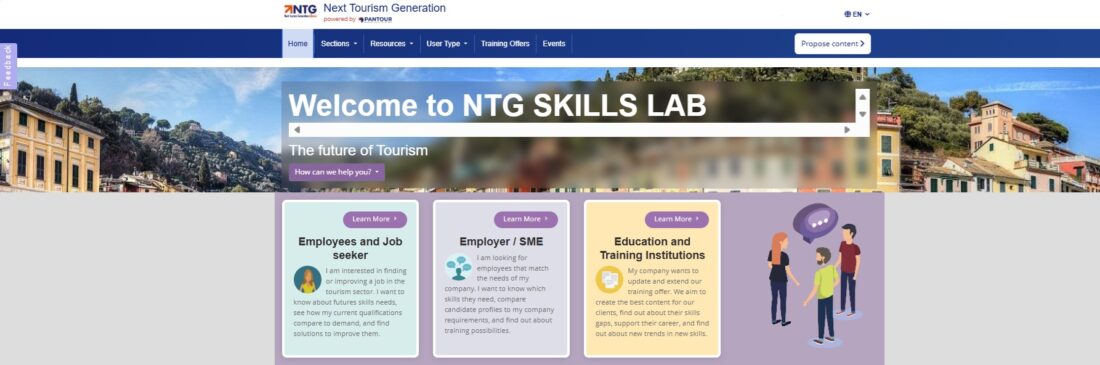
The main functionalities of the skills lab are linked to matching existing skills and skills requirements, and provide guidance to cover gaps that are detected. These functionalities are implemented in a logical sequence for three different user groups: employees and job seekers; employers / SMEs, and Education and Training Institutions. For example, a job seeker first shall generate his own skills profile. This allows to match this profile with the skills requirements for a specific position to detect gaps, or to find the positions that match best with this individual profile. Depending on the gaps detected, then the system suggests possible training options. For a tourism SME, the sequence is similar but allows to define customized skills requirements for a position which can then be matched with candidate’s skill profiles. Finally, training institutions can match their existing materials to the generic requirements, assess the best training for a student, and gain access to training resources such as lesson plans or training templates.
Additionally, the Skills Lab provides information on training offers, events, and other resources related to training such as networks, organisations, etc. Any of these can be proposed as external content by any interested party, and after passing a validation, form part of the Skills Lab database.
What is the framework of the Tourism Skills Lab?
At the heart of the Skills Lab, you find the tourism skills matrix that was already described above. This matrix defines the required level of 35 core skills depending on four dimensions (sub-sector, size, task, and hierarchy level). The related skills levels can be modified and new skills can be added, which assures a high degree of flexibility and scalability. These skills levels can then be used for the current and upcoming functionalities that may appear in the future.
Additionally, the uptake and use of the Skills Lab by a large number of users would provide a potential for real-time skills intelligence. For example, the most important gaps between existing skills, demand, and training available; changes in required levels; or the definition of new occupational profiles.
Who are the user groups of the Tourism Skills Lab?
Currently the Skills Lab has three defined user groups: students, employees and jobseekers; tourism businesses or equivalent; and Education and Training Institutions. For each of them, the relevant functionalities are directly accessible from the main menu. At the moment, a registered user can access all three groups of functionalities, however it is foreseen to limit some of them only to the user group defined in the user profile.
Where can professionals find the Tourism Skills Lab?
The Skills Lab is available free of charge at the URL https://tourismskillslab.eu/. A limited number of functionalities is directly available, but to make use of the functionalities as indicated above it is necessary to register through a simple process (via Google ID, Microsoft ID, or by custom indication of email, password, and type of user). After registering, any profiles or other information generated by the user is stored on the Skills Lab for future use.
Due to being a new system, some bugs may still appear during the use. These can be reported directly from the interface with a “feedback” button.
What new developments are in the pipeline?
The Skills Lab is a self-standing system but it is open for extension, integration into a wider platform, and for linkeage with external systems. Some of the current ideas include a new user group for job intermediaries, data-mining for skills intelligence, and the integration in the upcoming FuTourAlliance Tourism Skills and Intelligence platform that shall include the Skills Lab, the Tourism LSP website within the Pact for Skills, and skills intelligence tools. Possible linkeage with external systems include the T4T – Tourism Transition Pathway platform and CEDEFOP-
How to start working with the Tourism Skills Lab?
On Thursday 28 May 2026, there will be a live workshop/demo of the Tourism Skills Lab. We invite employees, employers, students, trainers, job seekers, and other professionals to join this interactive webinar where we will experiment and discuss the use of the Tourism Skills Lab. Don’t miss it and send an email to info@nexttourismgeneration.eu to register.
Yeliz Dayana Rodríguez Alonso
May 25, 2026 at 10:08 AMEstoy muy interesada en la charla
Yeliz Dayana Rodríguez Alonso
May 25, 2026 at 10:11 AMI am very interested in attending this webinar, as I believe it is a great opportunity to expand my knowledge of the tourism sector, learn about current trends, and discover new ideas and strategies that can be applied professionally and academically.